ea879271.webexamgh.com

LEARNING EXPERIENCE

Learn by Making.
Grow Through Practice.

Graphic Design education develops through more than learning tools. Students strengthen their creative ability by investigating problems, developing ideas, producing work, discussing decisions and refining outcomes through continued practice.

HOW LEARNING HAPPENS

Creative Ability Develops Through Practice.

The department’s educational approach places emphasis on practical capability, technological awareness and the development of skills that can be applied through Graphic Design practice. Learning becomes stronger when students can move between thinking, making, evaluating and improving.

“
Understand the problem.
Explore possibilities.
Make something.
Learn from what happens.
”

THE DESIGN PROCESS

Every Project Begins With a Question.

01

Understand

Clarify the problem, purpose and communication need.

02

Research

Investigate context, references and possible directions.

03

Explore

Generate alternatives through sketching, studies and experimentation.

04

Develop

Turn selected ideas into stronger visual systems.

05

Critique

Discuss decisions, identify weaknesses and consider alternatives.

06

Refine

Strengthen the final outcome through deliberate improvement.

CRITIQUE & REFLECTION

Good Design Gets Stronger When Decisions Are Questioned.

Critique creates an opportunity to explain the thinking behind a design, hear different perspectives and reconsider decisions that may not yet communicate effectively.

Present

Explain the concept and reasoning behind the work.

Discuss

Consider how other people understand and respond to it.

Improve

Use feedback as information for further development.

BUILDING CAPABILITY

The Tool Is Only One Part of the Work.

Graphic Design requires technical ability, but software alone does not determine whether communication is effective. Students also develop judgment around hierarchy, typography, composition, image, production and the relationship between visual choices and purpose.

TOOLS HELP
YOU MAKE.

DESIGN THINKING
HELPS YOU DECIDE
WHAT SHOULD BE MADE.

A BROADER EDUCATIONAL FOUNDATION

Creative Practice Connects With More Than Visual Craft.

Competence

Develop practical abilities that can be applied through creative processes and production.

Technology

Build awareness of the tools and technological contexts through which contemporary Graphic Design is developed.

Management

Strengthen organisation, planning, communication and responsibility around creative work.

Entrepreneurship

Develop awareness of how creative capability can connect with professional and business opportunities.

RESEARCH & EXPLORATION

Strong Visual Decisions Need Something to Be Based On.

Research helps a designer understand context before making decisions. Depending on the communication problem, this may involve examining audiences, existing visual material, cultural references, production conditions or competing forms of communication.

● What is being communicated?

● Who needs to understand it?

● What context does it exist within?

● What visual approach supports the purpose?

TESTING POSSIBILITIES

The First Idea Does Not Have to Be the Final Idea.

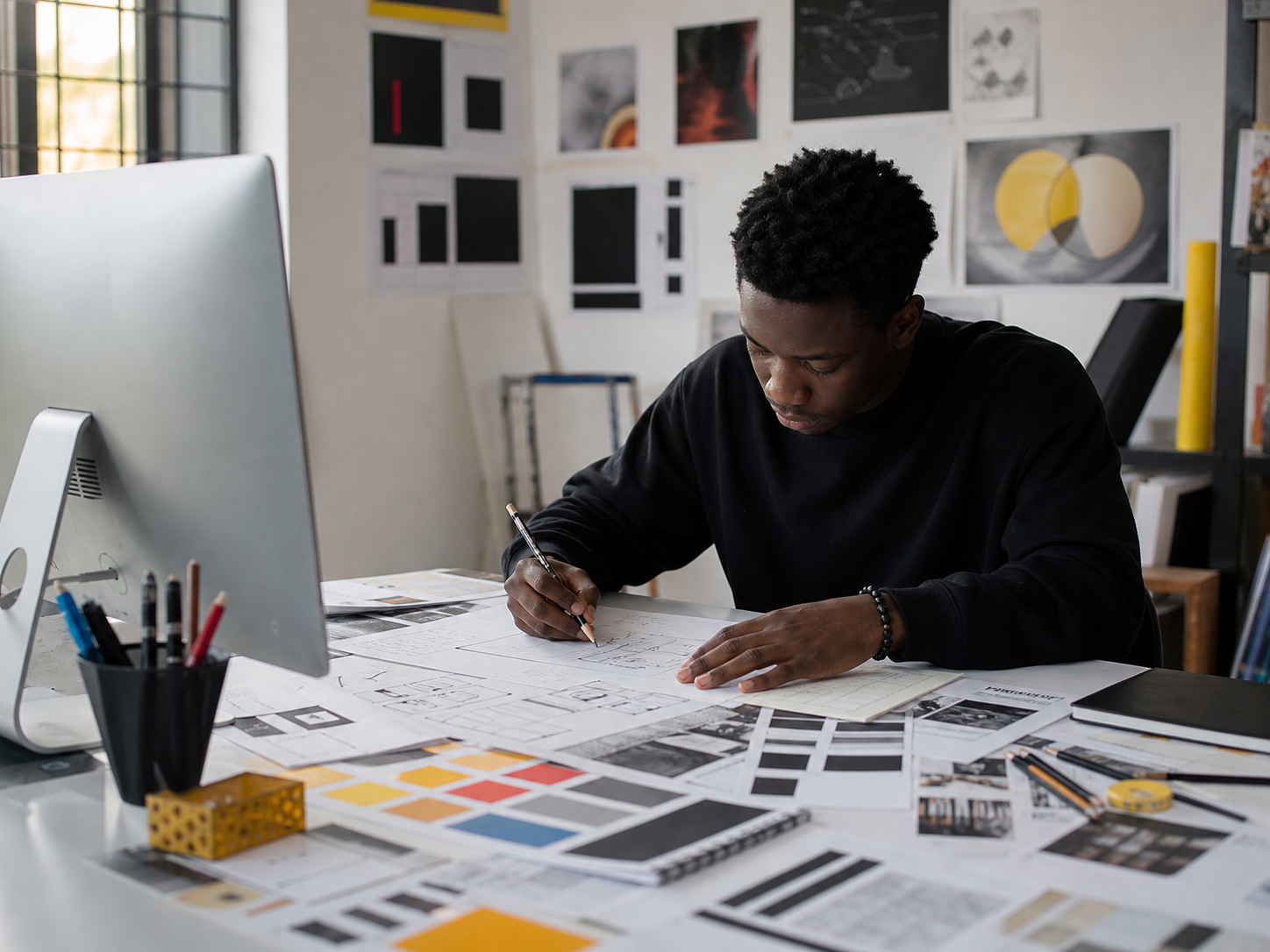
Experimentation creates room to test different ways of communicating before committing to a final direction. Changes in type, scale, image, colour, structure or material can produce different interpretations of the same idea.

Variation

Comparison

Selection

Development

MAKING & PRODUCTION

Design Has to Leave the Sketchbook Eventually.

Practical Graphic Design requires ideas to move toward finished forms. Production introduces another level of decision-making: scale, material, format, reproduction, legibility and the way the final outcome will actually be experienced.

Print

Consider format, reproduction, colour and physical handling.

Physical Applications

Consider structure, materials, scale and environment.

Digital Outcomes

Consider screens, responsiveness, hierarchy and interaction.

PRESENTATION

A Designer Should Be Able to Explain the Decision, Not Just Show the Result.

Presenting creative work requires students to organise their thinking, communicate the purpose of a project and explain how visual decisions relate to the problem being addressed.

Context

What problem was being addressed?

Concept

What idea guided the visual direction?

Process

How did the work develop?

Outcome

Why does the final solution look and function the way it does?

REFLECTION & GROWTH

Every Finished Project Creates Information for the Next One.

Reflection helps students identify what worked, what could have been stronger and what they would approach differently in future work. Creative development therefore continues beyond the final submission.

Make → Review
Learn → Apply
Make Again

PROFESSIONAL AWARENESS

Creative Practice Also Requires Responsibility.

Organisation

Manage files, tasks and stages of development clearly.

Communication

Present ideas and decisions in ways other people can understand.

Consistency

Maintain quality across different parts of a visual system.

Responsibility

Consider context, audience and the consequences of communication decisions.

WHERE THE LEARNING CONNECTS

The Process Changes With the Problem. The Principles Stay Connected.

Visual Communication

Explore typography, image, information and editorial structure.

Digital Design

Explore visual systems designed for screens and interaction.

Branding & Packaging

Explore identity, packaging and physical brand applications.

LEARN THROUGH PRACTICE

Ideas Become Stronger
When You Work With Them.

Scroll to Top